
Blog
Australia’s 2025–26 Migration Program: A Skills-Focused Future
Australia has confirmed that its 2025–26 Migration Program will remain at 185,000 permanent places, maintaining a strong focus on skilled migration, regional development, and family reunification. The program introduces the new Talent & Innovation visa, strengthens state and territory nomination pathways, and ensures stability while balancing economic and social priorities.
Reviewed by Katrin Maja O'Flynn
Migration rules change regularly. Treat this article as a policy snapshot and confirm current requirements with a licensed advisor before relying on it.

On 2 September 2025, the Australian Government confirmed that the 2025–26 permanent Migration Program will remain at 185,000 places, a continuation of the 2024–25 settings. This decision underscores a consistent, skills-focused approach that balances economic priorities with family reunification and social cohesion.
Program Composition
The program is structured into three main streams:
- Skill stream – 132,200 places (71%) Targeted at boosting productivity and addressing skill shortages across Australia, with particular focus on regional areas.
- Family stream – 52,500 places (28%) Largely Partner visas, designed to reunite families and provide clear pathways to citizenship.
- Special Eligibility stream – 300 places (<1%) For unique circumstances, including returning permanent residents.
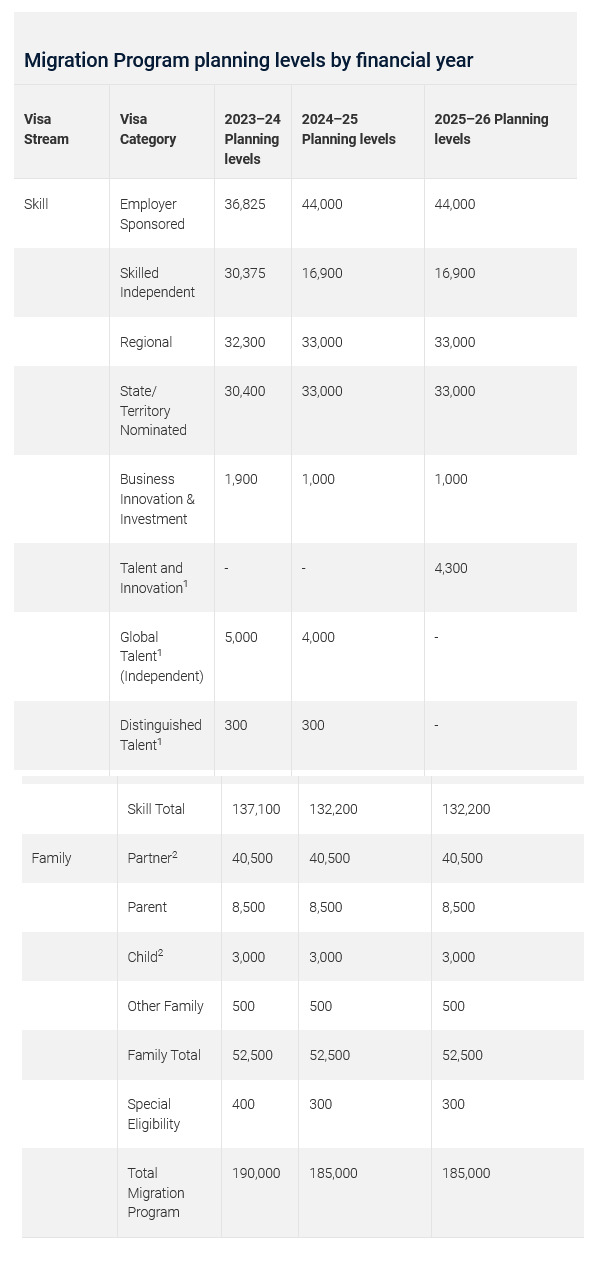
The introduction of the Talent & Innovation category (4,300 places) marks a significant transition, consolidating the former Global Talent and Distinguished Talent visas into the new National Innovation visa. Importantly, existing applicants for the older visa types will not be disadvantaged.
Strategic Focus: Regional & State/Territory Nominations
Regional and state/territory nominated visas now account for:
- 36% of the overall program, and
- 50% of the Skill stream.
This emphasis ensures jurisdictions can directly attract skilled migrants aligned with local labour force needs. Each state and territory sets its own criteria, reinforcing a decentralised, responsive approach to migration. Once states and territories receive their allocations, they will move on to design the 2025–26 program for state and territory visa nominations (subclass 190 and 491 visas), tailoring their strategies to address local economic and workforce priorities.
Family Stream: Steady and Demand-Driven
The Partner visa program continues under a demand-driven model, while the Child visa program remains fixed at 3,000 places but prioritises family reunification to uphold Australia’s international obligations. Both ensure the social fabric of migration remains strong alongside economic drivers.
Migration Program vs Net Overseas Migration (NOM)
It’s important to note that the Migration Program is only one part of the bigger picture of net overseas migration (NOM):
- NOM includes temporary migration (e.g., students, working holiday makers), as well as citizens and humanitarian entrants.
- In 2023–24, 61% of permanent skilled visas and 47% of permanent family visas went to applicants already onshore.
- This means the Migration Program has a limited short-term impact on housing, infrastructure, and services, as many recipients are already part of local communities.
Looking Ahead
The 2025–26 program reflects stability and foresight:
- Continued focus on skills and regional growth.
- Strong pathways for family reunification.
- A forward-thinking pivot toward innovation through the new visa stream.
This balance between economic productivity, social cohesion, and sustainable migration management positions Australia to remain globally competitive while ensuring that growth is aligned with community capacity.
To stay updated on all things Australia and New Zealand migration, we welcome you to connect with us by subscribing to our newsletter.